


Insights
Cyber incidents are now a daily operational risk. The real question for organisations isn’t if an incident will happen — it’s whether they have the people to prevent, detect and respond effectively.
In this article
The question is not whether your organisation will face a cyber incident. The question is whether you will have people capable of preventing it, detecting it quickly, and responding effectively when it happens.
The numbers paint a stark picture
The (ISC)² research surveyed cybersecurity professionals and business leaders across global markets. The findings reveal a crisis that extends well beyond simple headcount shortages.
The global cybersecurity workforce gap stands at approximately 4 million professionals. This represents the difference between the current workforce and the number of cybersecurity professionals organisations report needing to defend adequately against current threats.
Europe faces particular pressure due to its regulatory environment and position as a major economic bloc. Frameworks led by GDPR and the NIS2 Directive create compliance obligations that require sophisticated cybersecurity capabilities. Meanwhile, Europe’s economic significance makes it a priority target for criminal organisations and sophisticated threat actors.
The workforce gap manifests in tangible ways. Organisations report that unfilled cybersecurity positions remain open substantially longer than other technical roles. During that time, the organisation operates with known gaps in its defensive capabilities whilst attack surfaces continue to expand.
More concerning, the gap is widening. Despite universities launching new cybersecurity programmes, professional certifications multiplying, and organisations investing heavily in training, the skills shortage has grown year over year. Traditional approaches to developing cybersecurity talent are not keeping pace with the speed at which threats evolve and attack surfaces expand.
Why the traditional pipeline is broken
The cybersecurity skills crisis persists despite substantial investment in solving it. Universities across Europe have launched dedicated cybersecurity degree programmes. Professional certification bodies offer increasingly sophisticated credentials. Governments have funded initiatives to attract people into the field.
Yet the gap widens. Understanding why requires examining what cybersecurity roles actually demand versus what traditional education provides.
A typical computer science degree develops strong foundational knowledge in programming, algorithms, networks, and systems. These are valuable skills. But modern cybersecurity roles require capabilities that extend well beyond technical implementation. Effective cybersecurity professionals need to understand business risk, communicate with non-technical stakeholders, navigate regulatory requirements, make decisions under uncertainty, and balance security requirements against operational needs.
Traditional degree programmes, constrained by academic structures and lengthy curriculum development cycles, struggle to keep pace with the threat landscape. The time lag between curriculum design and graduate employment means students learn about threats, tools, and techniques that may already be outdated.
Professional certifications address some limitations by focusing on current practices and technologies. But they typically develop narrow expertise in specific domains or tools. Organisations need people who can think holistically about security across technical, business, and regulatory dimensions — not specialists who understand components in isolation.
The mismatch extends to how we identify potential cybersecurity professionals. Traditional pathways assume people begin with technical backgrounds, typically computer science or IT. This excludes talented individuals from other fields who might excel at the strategic, analytical, and communication aspects of cybersecurity but lack the technical foundation that traditional programmes require as prerequisites.
What organisations actually need
The (ISC)² research identifies critical cybersecurity skill gaps that organisations struggle to fill. The responses reveal a pattern that traditional education largely ignores.
Technical skills matter, certainly. Organisations need people who understand network security, cloud architecture, identity and access management, and incident response procedures. But the most acute shortages are not purely in these technical areas. They are in capabilities that bridge technical and business domains.
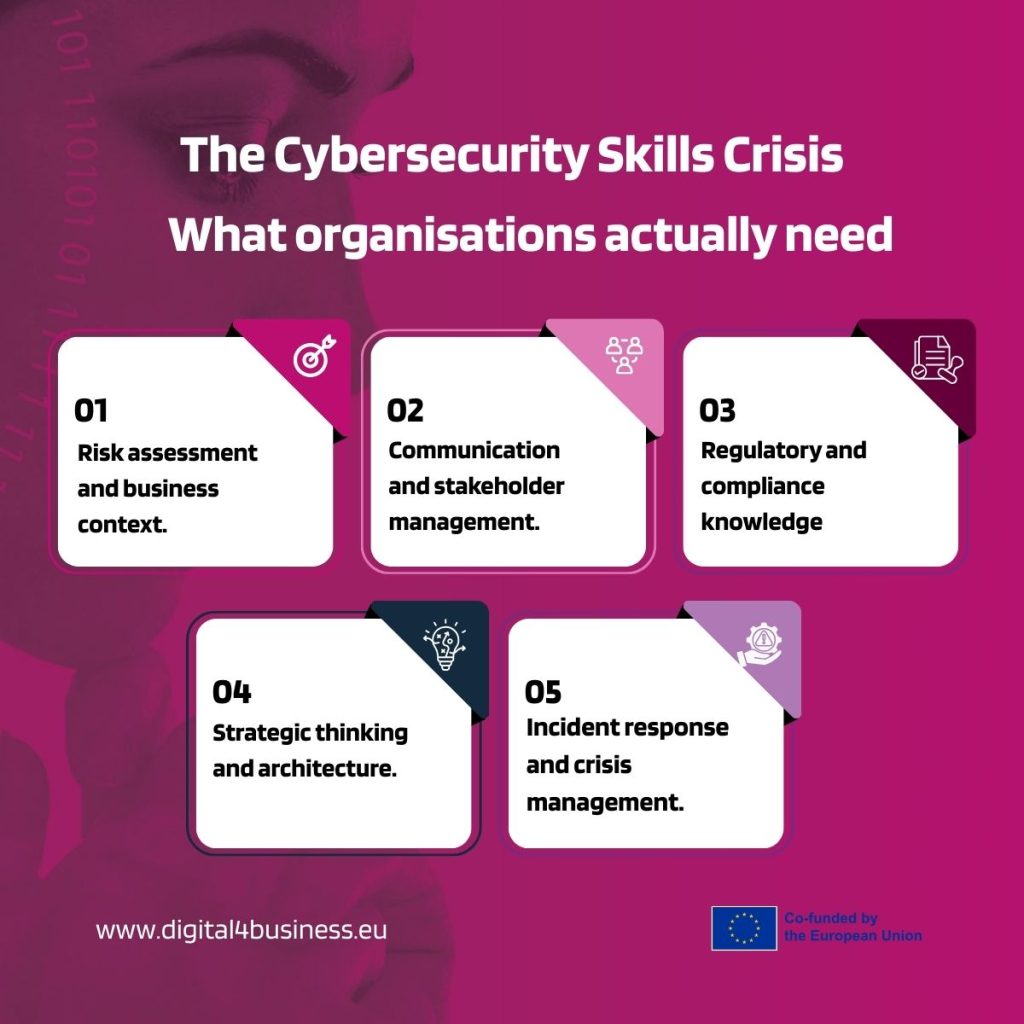
Risk assessment and business context. Organisations struggle to find cybersecurity professionals who can evaluate security risks in business terms. What is the actual financial impact of a particular vulnerability? How do you prioritise security investments when you cannot protect everything equally? When should you accept risk rather than spending resources to mitigate it? These questions require understanding both the technical attack vectors and the business context in which security decisions get made.
Communication and stakeholder management. Security teams regularly fail because they cannot explain technical risks in terms that business leaders understand and act upon. A brilliant security architect who cannot build support for necessary changes across operations, legal, compliance, and business units creates limited value. Organisations need cybersecurity professionals who can translate between technical and business languages.
Regulatory and compliance knowledge. GDPR, NIS2, sector-specific regulations, and emerging frameworks create complex compliance obligations that require both legal interpretation and technical implementation. Few cybersecurity professionals understand both sides sufficiently to guide organisations through this landscape effectively.
Strategic thinking and architecture. As organisations adopt cloud services, edge computing, Internet of Things devices, and AI systems, their attack surfaces become vastly more complex. Defending this requires people who can think architecturally about security across distributed systems, not just implement controls in isolated components.
Incident response and crisis management. When breaches occur, the technical aspects of containment and remediation represent only part of the challenge. Organisations need people who can coordinate across teams under pressure, make rapid decisions with incomplete information, manage communications with regulators and affected parties, and extract lessons that prevent recurrence.
These capabilities share a common characteristic. They require cybersecurity knowledge situated within broader business, regulatory, and organisational contexts. This is precisely what traditional education struggles to provide.
The hidden cost of the skills gap
The cybersecurity skills shortage is not an abstract HR problem. It translates directly into business risk and financial impact.
When organisations cannot fill security positions, they operate with known gaps in their defences. Security tools generate alerts that nobody has time to investigate. Vulnerabilities remain unpatched longer. Security architecture decisions get made by people who lack the expertise to evaluate trade-offs properly. The organisation’s actual security posture degrades even as security budgets increase.
The financial implications are substantial. Data breaches create costs through incident response, regulatory fines, legal expenses, business disruption, and reputational damage. For many organisations, particularly small and medium enterprises, a significant breach represents a serious threat to business continuity.
Beyond direct financial costs, the skills gap creates opportunity costs. Organisations delay digital transformation initiatives because they cannot staff security adequately for new cloud deployments, IoT implementations, or AI systems. Innovation slows when security becomes a bottleneck rather than an enabler.
The regulatory environment compounds these pressures. GDPR violations can result in fines up to 4% of global annual revenue. The NIS2 Directive, which came into force in 2023 with implementation deadlines through 2024-2025, extends security requirements to a much broader range of organisations and includes potential personal liability for senior management. Compliance with these frameworks requires cybersecurity capabilities that many organisations simply do not have.
Perhaps most concerning, the skills gap affects the professionals who remain in the field. Understaffed security teams face relentless pressure, long hours, and the stress of knowing they cannot possibly address all the risks they identify. This contributes to burnout and turnover, further deepening the shortage.
Why Europe faces unique challenges
Whilst the cybersecurity skills shortage is global, Europe faces particular pressures that intensify the crisis.
The regulatory environment in Europe is among the world’s most demanding. GDPR established high standards for data protection. The NIS2 Directive extends security requirements across critical infrastructure and digital service providers. Sector-specific regulations in finance, healthcare, energy, and telecommunications add additional layers of compliance obligation. The EU AI Act introduces requirements for security in AI systems.
This regulatory complexity creates demand for cybersecurity professionals who understand not just technical security but also legal compliance, risk governance, and regulatory reporting. These hybrid capabilities are scarce globally but particularly so in Europe, where regulatory frameworks are still relatively new and evolving.
Europe’s diverse linguistic and regulatory landscape also complicates talent development. A cybersecurity professional in one member state needs to navigate GDPR plus national law plus potentially regional requirements. Someone in another member state faces a different regulatory stack. This fragmentation makes it harder to develop standardised educational programmes that serve the entire European market.
Europe also faces competition for cybersecurity talent from other global markets. Retaining top talent requires creating compelling career paths and professional development opportunities that keep people engaged and growing.
What actually works
Effective cybersecurity education integrates technical depth with business context. This means not teaching network security in isolation but rather teaching it alongside business risk assessment, regulatory compliance, and organisational change management. Students learn not just how attacks work but also how to evaluate their business impact, prioritise defensive investments, and communicate risks to non-technical stakeholders.
Programmes that work also emphasise practical application. Cybersecurity is not a field where theoretical knowledge translates automatically to effective practice. Professionals need experience making decisions under uncertainty, responding to simulated incidents, balancing competing priorities, and learning from failure in controlled environments before they face real attacks.
Successful approaches also recognise that cybersecurity talent can come from diverse backgrounds. Some effective security professionals began in fields like law, business, or other disciplines before transitioning into cybersecurity. Their non-technical backgrounds often provide valuable perspectives on risk, human behaviour, organisational dynamics, and strategic thinking.
Finally, effective development recognises that cybersecurity learning must be continuous. The field evolves too rapidly for any fixed curriculum to remain current. Professionals need frameworks for ongoing learning, ability to evaluate new developments critically, and confidence to adapt as threats and technologies change.
The Digital4Business approach to cybersecurity
The cybersecurity module within the Digital4Business Joint Professional Master’s programme directly addresses the gaps that traditional education leaves unfilled.
Rather than teaching cybersecurity as a purely technical discipline, the programme integrates it with business strategy, regulatory compliance, risk management, and organisational change. Students develop technical understanding of threats, vulnerabilities, and defensive measures whilst simultaneously building the business acumen to apply that knowledge effectively in organisational contexts.
The curriculum covers essential technical foundations including network security, cloud security architecture, identity and access management, cryptography, and incident response. But it situates this technical content within frameworks for risk assessment, compliance management, security governance, and strategic decision-making.
Importantly, the programme develops capabilities that traditional cybersecurity degrees often ignore. Students learn to communicate security risks to non-technical stakeholders, build business cases for security investments, navigate complex regulatory requirements across GDPR and sector-specific frameworks, and lead security initiatives in organisations where change management is as important as technical implementation.
The programme also connects cybersecurity to the broader digital transformation landscape. Modern security cannot be treated in isolation from cloud architecture, data analytics, AI systems, and blockchain implementations. Digital4Business students develop integrated understanding across these domains, recognising that effective security requires holistic thinking about technology, data, and business processes.
Designed for working professionals, the programme allows students to apply learning directly to real organisational challenges. This practical application accelerates skill development and ensures that knowledge translates to capability rather than remaining theoretical.
What this means for your career
The cybersecurity workforce data presents a clear picture for professionals considering cybersecurity careers or looking to transition into the field.
Demand substantially exceeds supply and will continue to do so for the foreseeable future. Organisations across industries need cybersecurity capabilities and struggle to find qualified professionals. This creates substantial opportunity for people willing to develop these skills seriously.
However, the skills organisations need are not what traditional cybersecurity education typically provides. Technical knowledge alone is necessary but insufficient. The professionals who command premium compensation and have choices about where they work are those who combine technical depth with business acumen, regulatory knowledge, strategic thinking, and communication skills.
This creates particular opportunity for professionals who come from diverse backgrounds. If you have business, legal, compliance, risk management, or operational experience combined with interest in developing technical cybersecurity knowledge, you may be better positioned than you realise. The hybrid capabilities you can develop are precisely what organisations need and cannot find.
The regulatory environment in Europe also creates specific opportunity. GDPR, NIS2, and sector-specific requirements mean organisations need professionals who understand both cybersecurity and compliance. This combination remains scarce and valuable.
Looking ahead, the cybersecurity skills gap will not close quickly through traditional education alone. This means professionals who invest in developing comprehensive cybersecurity skills now will find strong demand for years to come.
The path forward
If the cybersecurity skills crisis and the opportunity it creates resonate with you, consider what developing these capabilities requires.
Start by assessing your current position honestly. If you come from a technical background, where are your gaps in business thinking, regulatory knowledge, and strategic communication? If you come from a business background, what technical foundations do you need to build credibility and evaluate cybersecurity decisions effectively?
Recognise that developing comprehensive cybersecurity capability requires structured learning over an extended period. Genuine capability requires integrating technical knowledge, business understanding, regulatory awareness, and practical application.
Evaluate whether your current role provides opportunities to develop these capabilities or whether you need to create those opportunities deliberately through additional education or different work experiences.
The Digital4Business programme represents one structured pathway to developing cybersecurity capability in the business context that organisations actually need. Designed for working professionals across Europe, it provides integrated technical and business education whilst allowing you to remain in your current role and apply learning to real challenges.
Register your interest for upcoming cohorts. If you recognise the cybersecurity skills gap as both a crisis for organisations and an opportunity for professionals, explore the programme at digital4business.eu.
Europe needs millions of additional cybersecurity professionals. More precisely, it needs professionals who can bridge technical expertise and business strategy to defend organisations effectively in an increasingly hostile digital environment. The question is whether you will be among them.
Interested in upcoming cohorts?
Register your interest and stay informed about programme updates, key dates, and new content.
Europe needs millions of additional cybersecurity professionals, especially those who can bridge technical expertise and business strategy. The question is whether you will be among them.


)