


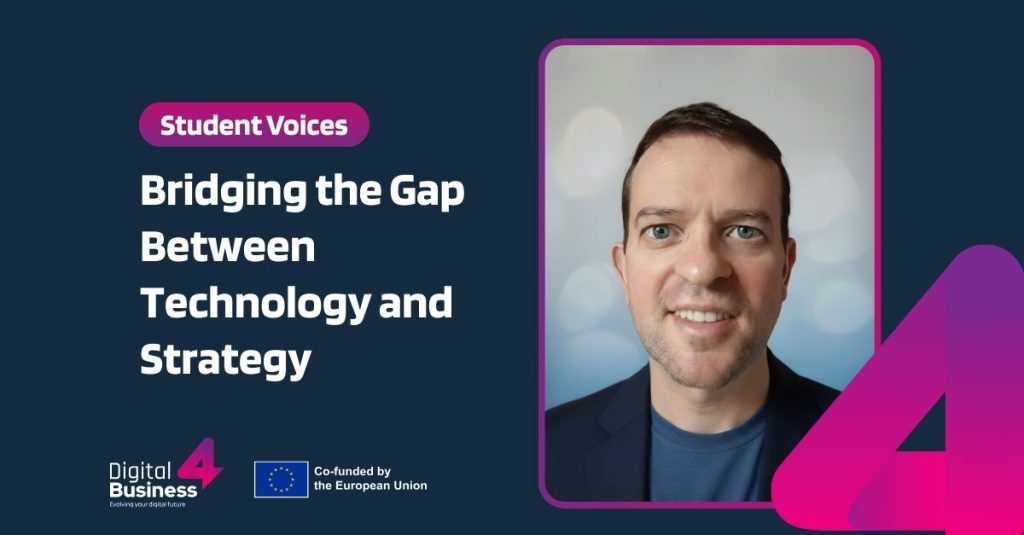
Bridging the Gap Between Technology and Strategy
Meet Luis Pereira:
Hi, I’m Luis, I’m originally from Portugal, and I’m currently living in Dublin, Ireland. Professionally, I come from a technical background — I work in IT Support (in a fast-paced environment where you’re constantly dealing with real-world problems, priorities, and people). Outside of work, I’m also a very hands-on “builder” type: I like learning new tools and thinking about how technology can solve everyday problems, whether that’s in business, operations, or even creative projects.
From Technical Support to Digital Transformation
“The biggest motivation was bridging the gap between being technical and being able to drive digital change at a higher level. I’ve worked close to systems, processes, and teams long enough to see how often companies struggle with the same things: siloed tools, unclear ownership, slow decision-making, and ‘we’ve always done it this way.’”
He reached a turning point in his thinking about his career trajectory.
“At a certain point I realised I didn’t just want to support the technology. I wanted to be able to shape the strategy, understand the business side deeply, and communicate confidently across both worlds: tech and business. That’s what pushed me to apply.”
The Decision to Apply
When considering different programmes, Digital4Business stood out for a specific reason.
“What made D4B feel like the right fit was the focus on digital transformation from a business perspective, without losing the practical side. I didn’t want something that was purely theoretical, and I also didn’t want a programme that was ‘just tech.’ I wanted the middle ground: learning how to think, plan, and execute digital initiatives in a way that actually works in real organisations.”
First Impressions and Getting Started
Luis’s initial experience with the programme set clear expectations from the beginning.
“My first impression logging in was honestly: OK, this is real. I’ll need to stay organised. In a good way. It felt structured and purposeful, not like random content thrown online.”
One aspect surprised him positively in the early weeks.
“How quickly it pushed me into a ‘real-world mindset.’ Even early on, you can feel that the programme wants you to connect ideas to what’s happening in your workplace, your industry, and your own goals, not just memorise concepts.”
The onboarding process helped Luis settle into the programme efficiently.
“I found the onboarding process smooth and well-structured. It made it clear what to do first and helped me get organised quickly.”
Building connections with fellow students also proved easier than Luis anticipated for an online programme.
“Between the introductions and discussions, you quickly realise everyone comes from different backgrounds but is dealing with the same challenge of balancing work, life, and study. That shared experience makes it feel more like a group than studying alone.”
The Learning Experience in Practice
When asked what has stood out so far in his studies, Luis points to the practical relevance of the content.
“What’s stood out most is the combination of frameworks and practical thinking. I’ve been enjoying topics that connect directly to how companies actually operate: things like digital strategy, transformation planning, data-driven decision-making, and how technology changes customer and employee experience.”
The teaching approach resonates with his learning style.
“The teaching style feels like a good balance: you get the concepts, but you’re also encouraged to apply them, to reflect on how it looks in your job, how you’d approach a challenge, or how a business could do it better.”
The connection to his daily work has been immediate and tangible.
“I already see a direct link to my work. For example, I often see simple requests turn into long back-and-forth because information is spread across different tools and teams, so people rely on manual workarounds. During a module discussion, I caught myself looking at that situation differently, not just ‘how do we fix the ticket,’ but how you’d redesign the process, align stakeholders, and measure impact. That shift in thinking has been a big takeaway for me so far.”
Balancing Study with Work and Life
Like many Digital4Business students, Luis is managing the programme alongside full-time work and family commitments.
He’s developed a practical approach to staying on track.
“I’m balancing the programme alongside work and family life, so I’ve learned quickly that consistency beats intensity. For me, a typical study week looks like a couple of evenings during the week for reading, videos, and notes, one focused block on the weekend for assignments or deeper work, and small ‘in-between’ moments. Even 20 to 30 minutes can move things forward if you keep momentum.”
The online format has proven advantageous for his situation.
“The online format has actually been a big advantage, because it allows me to study without needing to pause life. It does require discipline, but the flexibility is worth it, especially if you’re working full-time.”
Looking to the Future
As the programme progresses, Luis is particularly excited about the more applied elements ahead.
“What I’m most looking forward to is going deeper into the more applied parts of the programme: projects, case work, and anything that strengthens my ability to lead or contribute to digital initiatives in a more formal way.”
He has clear expectations about how the Master’s will influence his career path.
“Long-term, I expect this Master’s to shift my trajectory toward roles where I’m closer to planning, delivery, and decision-making, not just solving technical issues, but helping shape what gets built, why it matters, and how it creates value.”
Advice for Prospective Students
For anyone considering applying to Digital4Business, Luis offers straightforward advice grounded in his experience so far.
“If you’re someone who’s curious about digital transformation and you want to level up your ability to operate between business and technology, it’s worth it. But come in with the right mindset: you don’t need to be ‘perfect’. You just need to be consistent, open to learning, and willing to apply what you’re learning to real life.”


)