


Posted on June 4, 2026
Europe’s digital future is moving to the centre of political, economic and business strategy.
On 3 June 2026, the European Commission presented its new Technological Sovereignty Package, a set of measures designed to strengthen Europe’s digital autonomy, resilience and competitiveness across critical technologies including semiconductors, artificial intelligence, cloud infrastructure and open source.
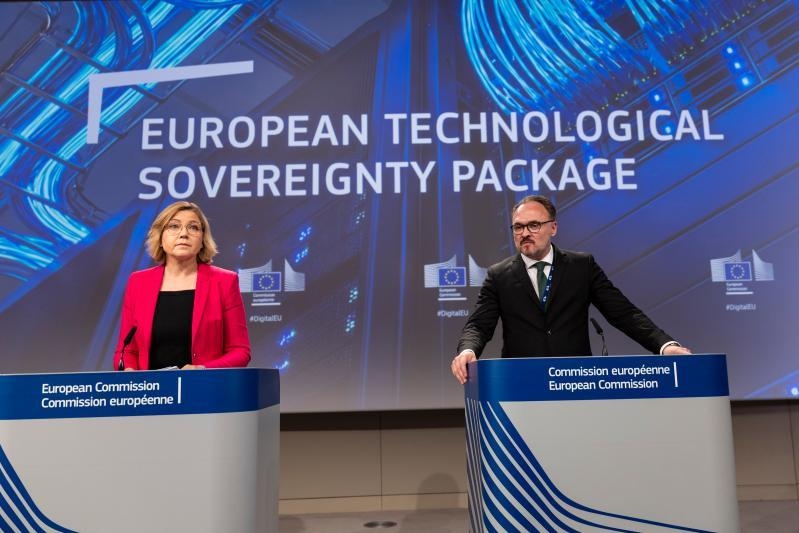
The package includes two legislative proposals, the Chips Act 2.0 and the Cloud and AI Development Act, alongside an Open Source Strategy and a Strategic Roadmap for Digitalisation and AI in the Energy Sector. Together, these initiatives reflect a clear ambition: Europe must be able to develop, scale and govern the technologies that will shape its economy, security and society.
“Europe has the talent, the research excellence, the industrial base and the Single Market. Together, we must turn these strengths into technological sovereignty.”
Ursula von der Leyen, President of the European Commission
As Executive Vice-President Henna Virkkunen said in her remarks on the package:
“One of my main missions was to secure Europe’s technological sovereignty.”
Henna Virkkunen, Executive Vice-President for Tech Sovereignty, Security and Democracy
This ambition is about more than infrastructure. It is about trust, governance, skills and leadership.
What technological sovereignty means for business
The European Commission describes technological sovereignty as Europe’s ability to develop, control and scale critical technologies, infrastructure, services and data. In practical terms, this means reducing risky dependencies, strengthening European capacity and ensuring that businesses, public administrations and citizens have access to secure, reliable and trusted digital systems.
For businesses, this is not an abstract policy issue. Decisions around cloud providers, AI tools, data storage, cybersecurity, digital supply chains and regulatory compliance are now strategic business decisions.
Organisations increasingly need to ask:
- How is our data governed?
- Where is our data stored and processed?
- How do we manage AI-related risks?
- Can we explain and justify data-driven decisions?
- Are our digital systems compliant, resilient and ethical?
As Europe invests in strategic technologies, businesses will need professionals who can understand both the opportunities and the responsibilities that come with digital transformation.
Data governance at the heart of digital autonomy
A key theme running through the technological sovereignty agenda is control. Not control in the sense of isolation, but control in the sense of capability, choice and responsibility.
Europe’s ambitions in AI, cloud and digital infrastructure depend on strong data governance. Without clear frameworks for managing data, organisations risk undermining the very trust that digital transformation depends on.
Good data governance helps businesses understand what data they hold, how it is used, who is responsible for it, how it is protected and how it can create value. It also supports compliance with legal and regulatory obligations, including privacy, data protection and emerging AI governance requirements.
This is particularly important as AI becomes more embedded in business decision-making. AI systems rely on data, but the quality, fairness, security and transparency of that data can determine whether those systems create value or create risk.
From policy ambition to practical leadership
Europe’s technological sovereignty goals will not be achieved through policy alone. They will depend on people who can translate policy, regulation and emerging technologies into practical business action.
That means developing a new generation of digital leaders who are confident working across business strategy, technology, data governance, ethics and compliance.
The Digital4Business Joint Professional Master’s Degree in Advanced Digital Technologies for Business is designed to help professionals build exactly this kind of capability. The programme brings together advanced digital technologies and business-focused learning, supporting graduates to understand how technologies such as AI, cloud, cybersecurity and data science can be applied responsibly in real organisational contexts.
One module that is especially relevant to Europe’s current policy direction is Data Governance and Ethics.
This module explores how data can be managed within legal and ethical boundaries. Students examine data governance frameworks, regulatory compliance, privacy and data protection, data risks, organisational ethics, AI governance and the societal impact of data-driven decision-making.
In a landscape where digital autonomy, resilience and trust are becoming business priorities, these are not optional skills. They are becoming core leadership capabilities.
Building Europe’s digital future responsibly
The Commission’s Technological Sovereignty Package signals a clear direction of travel. Europe wants to strengthen its position in the technologies that will define the coming decade, from chips and cloud to AI and open source.
For businesses, the message is equally clear. Digital transformation is no longer just about adopting new tools. It is about making informed, responsible and strategic choices about technology, data and governance.
Europe’s digital future will require investment in infrastructure, innovation and regulation. But it will also require people who understand how to lead responsibly in a complex digital world.
That is where education and upskilling have a vital role to play.
Through programmes such as Digital4Business, professionals can build the knowledge and confidence needed to support ethical, compliant and forward-looking digital transformation across Europe.
Explore the Data Governance and Ethics module and learn how Digital4Business is helping to shape the next generation of digital leaders.