


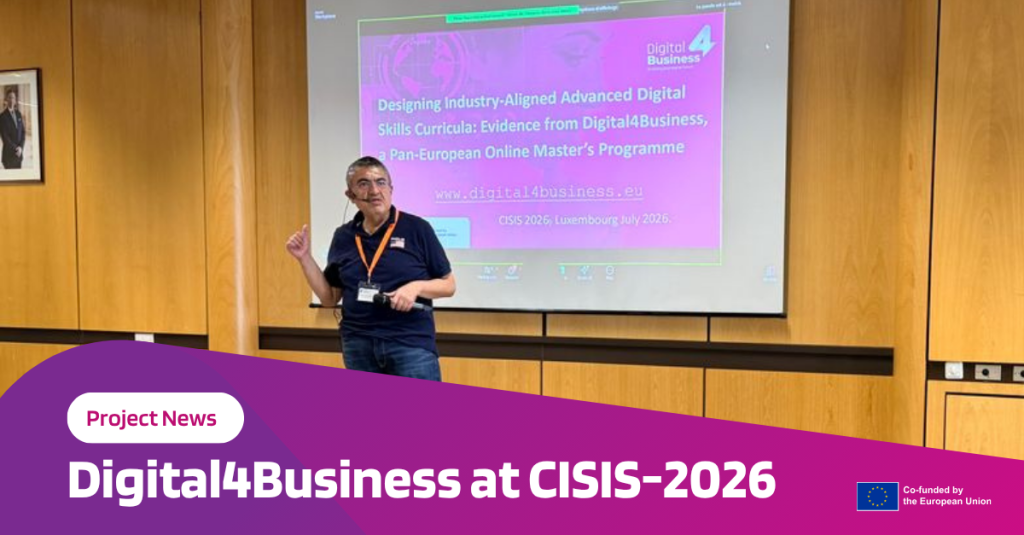
Digital4Business took the stage today at the 20th International Conference on Complex, Intelligent, and Software Intensive Systems (CISIS-2026), hosted by the University of Luxembourg from 1 to 3 July 2026.
Professor Horacio González-Vélez, Professor of Computer Systems at National College of Ireland, Founding Head of the Cloud Competency Centre, and General Coordinator of Digital4Business, presented the paper:
“Designing Industry-Aligned Advanced Digital Skills Curricula: Evidence from Digital4Business, a Pan-European Online Master’s Programme.”
The presentation took place earlier today, Thursday 2 July, as part of CISIS-S6: Multimedia Systems and Web Applications, from 11:30 to 13:00 CEST.
CISIS brings together research across complex systems, intelligent systems and software-intensive engineering. It is a forum for exploring how digital systems can be designed to adapt, scale, respond to risk and support real-world transformation.
Against this backdrop, Digital4Business presented a clear message: Europe does not simply need more digital education. It needs advanced digital education that is better aligned with labour market needs, industry demand and the practical realities of digital transformation.
The paper explored how Digital4Business has approached this challenge through the design and delivery of a fully online, cross-institutional Master’s programme. It examined how modular curricula, challenge-based learning, industry co-design, embedded professional certifications and shared digital infrastructure can work together to support advanced digital skills development at European scale.
The research focused on the Joint Professional Master’s in Advanced Digital Technologies for Business, with particular attention to curriculum design, learner pathways, assessment approaches and industry relevance.
Early evidence from the programme’s delivery was also presented, including enrolment patterns, modular demand, learner demographics and industry-facing design features. The findings showed strong demand for AI-oriented and digital transformation modules, reflecting the growing importance of these areas across the European economy.
The paper also reported a gender distribution of approximately 57% male, 41% female and 2% undisclosed. While gender parity remains an ongoing objective in advanced ICT education, these figures point to encouraging movement towards broader participation.
“Europe’s digital skills gap is often described as a pipeline problem,” said Professor Horacio González-Vélez. “Our evidence suggests it is also a design problem. Curricula must be built with industry, delivered flexibly, assessed rigorously, and improved continuously. Digital4Business is our attempt to turn that principle into a working European system.”
The paper argued that advanced digital skills programmes must be more than catalogues of emerging technologies. They must be designed as adaptive systems in their own right, governed across institutions, grounded in evidence, supported by digital platforms and assessed through authentic professional outputs.
Using a design-based research approach, the study proposed transferable design principles for cross-institutional postgraduate computing education. These included evidence-based curriculum scope, authentic learning with appropriate scaffolding, cross-institutional assessment calibration, platform-enabled pedagogy and iterative governance.
The presentation marked an important dissemination milestone for Digital4Business, bringing its work on advanced digital skills education into direct conversation with the wider software-intensive systems research community.
That connection matters. AI, cybersecurity, cloud computing and data-intensive platforms will not be deployed responsibly at scale unless Europe can also develop the human capability needed to design, govern and improve them.
Or, put less formally: the future of European digital transformation will not be debugged by technology alone.