


Posted on August 31, 2026
Digital4Business at the 4th International Conference on Digital Science in Education
In Digital4Business, our learners study across countries, institutions and professional contexts, on a programme designed to connect advanced digital knowledge with the realities of working life.
In Digital4Business, our learners study across countries, institutions and professional contexts, on a programme designed to connect advanced digital knowledge with the realities of working life.
This is an innovative way of learning: the programme is delivered fully online, allowing participants to remain where they live and work while accessing leading expertise from across Europe, from Ireland, Sweden, Italy and Portugal, enriched by contributions from further partner countries. In other words, people and expertise blend in ways that would hardly be possible within the boundaries of a conventional physical university setting.
The 4th International Conference on Digital Science in Education, held in Germany on 28–29 May 2026, provided a valuable context to reflect on this transformation.
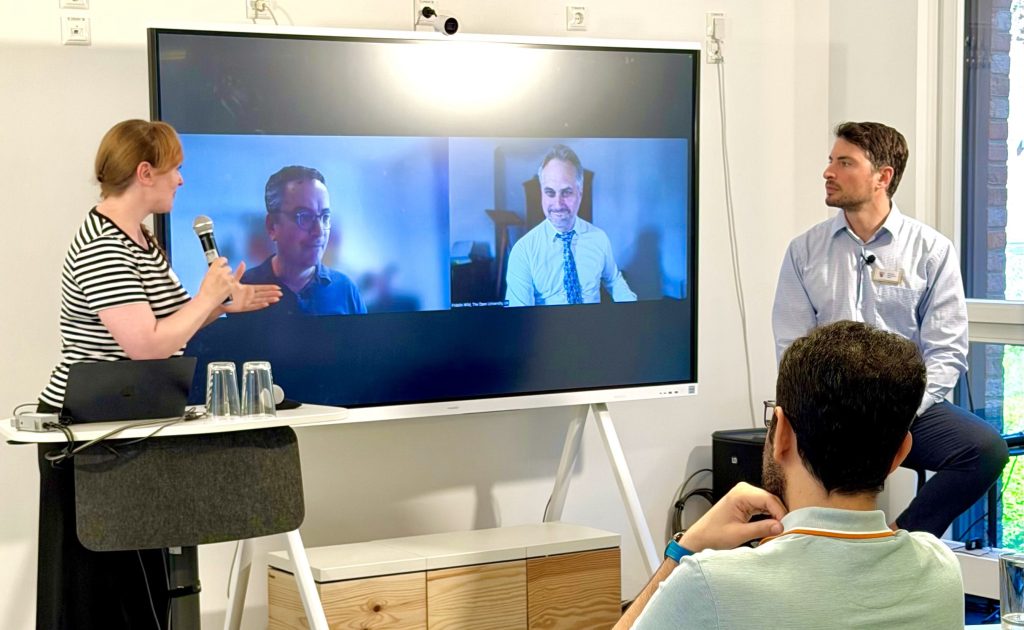
The panel Redefining the Campus Experience in a Digital World brought together experts in digital higher education design. It comprised Prof. Dr. Daniele Di Mitri, who heads Multimodal Learning Technologies at the German University of Digital Science; Prof. Dr. Roland Klemke, holding the Chair of Technology-Enhanced Learning and Innovation at the Open University of the Netherlands and a Professorship in Game Informatics at Cologne Game Lab; and Prof. Dr. Fridolin Wild, heading Technology-Enhanced Learning at the Open University UK. The session was moderated by Prof. Dr. Julia von Thienen, who represented the Digital4Business perspective in the discussion.
A seemingly simple question opened the session: what actually is a university, particularly when students no longer need to share a physical campus? Is it an online platform? A teaching and learning community? A learning experience? A service? Or yet something different, maybe something we are only just inventing as we go along?
The panel did not arrive at one definitive answer, and that may be a good sign. When established boundaries such as those of campus-based teaching disappear, settling too quickly on the first answer that comes to mind may simply reproduce solutions already familiar from the past rather than exploring opportunities that are only just emerging.
Instead, the panel discussion yielded a cornucopia of observations, possibilities and even points of scholarly friction. Discussions like these show that everyone, including the reader of this article, is invited to think about what the university of the future could or should become. Here are a few selected impressions.
Start with an Open Horizon
The session began with guest speakers Tim Strauch and Philip Steigerwald, who introduced COVE, the Campus of Virtual Education developed at German UDS. Crucially, their ambition is not simply to recreate a university building online. Why use the freedom of virtual space to construct another endless corridor, or library desks facing a building wall?
Instead, COVE is envisaged as an evolving campus that students can help shape themselves: creating spaces, organising watch parties and meet-ups, contributing through projects and research, and potentially even connecting to virtual spaces created by industry partners.
Two design examples may illustrate the idea: if your virtual library can offer an inspiring view over the ocean rather than onto the blank wall of a neighbouring building, why shouldn’t it? And if a lecturer is demonstrating something at the front of a huge virtual lecture hall, why sit craning your neck behind countless rows of other students when your avatar could simply fly over to the podium and inspect the demonstration from above?
Behind such playful examples sits a serious proposition. Physical campuses are shaped by gravity, available land, existing buildings, budgets and countless other practical constraints. Once the university moves online, many of these constraints disappear.
This allows a rather different question to take centre stage: what kind of environment might be best suited to help students learn, build a community with others, grow professionally and personally, become inspired, and feel welcome or even at home in their university?
Learning from Gaming Communities
At this point, Prof. Roland Klemke takes a step back to consider the broader picture: a 3D campus can create presence and identity, yet if students simply want to complete a learning task, making them manoeuvre an avatar through virtual buildings might add friction rather than value.
One source of inspiration he emphasises is online gaming. The field of online game design has spent decades learning how to make people who are physically far apart feel part of something together.
Large and initially anonymous communities can become socially meaningful when people repeatedly encounter one another in smaller groups, collaborate or compete, and may develop recognisable identities. This offers intriguing inspiration for online universities, both for the design of educational activities and for the environmental settings in which they take place.
Roland further describes a trend towards “education hopping”: learners increasingly assemble courses and micro-credentials from different providers. Such flexibility opens valuable opportunities, but it also creates a new design challenge.
If changing one’s university becomes almost as easy as changing browser tabs, what makes someone say: this is my university, a community and institution to which “I belong” and perhaps remain connected long after completing a course?
From Photo-Realism to Psychological Realism
Prof. Daniele Di Mitri offers one of the panel’s strongest provocations: new technology must not simply become a technical fix for a pedagogical model that may itself need reconsideration.
Generative AI makes this particularly tangible. If substantial parts of conventional assignments can now be generated automatically, and educators cannot reliably determine what represents a learner’s independent work, then familiar ways of assessing learning themselves become open to question.
Similarly, putting a two-hour lecture on Zoom does not magically reinvent teaching. Putting the same lecture inside a beautiful 3D world will not do so either.
Daniele instead encourages redesigns centred on forms of pedagogy that may be both desirable and feasible in the digital age. He further invites consideration of what new media uniquely make possible: exploration, spatial interaction, embodiment and new forms of participation. Does online learning, for example, really need to mean sitting still at a desk looking at a screen?
He also draws an intriguing distinction between photorealism and psychological realism. A digital world need not look remotely like a faithful copy of the analogue world, such as a familiar campus.
Highly stylised gaming environments already demonstrate that people can feel genuinely connected to communities and places populated by cartoon-like avatars or digital worlds built from Minecraft-like blocks. What matters may be less whether a digital environment looks real than whether the interactions within it feel meaningful.
This question becomes still more interesting as generative AI sweeps into education. A perfectly rendered AI lecturer may look human without making an encounter feel human. For Daniele, authenticity and meaningful human contact therefore remain core design considerations rather than problems that can be solved simply by increasing the fidelity of a digital replica.
What if Everyone Could Look Over the Expert’s Shoulder?
Prof. Fridolin Wild shifts attention from recreating campus life towards experiences that digital technologies may make possible for the first time.
Much professional learning still happens through observation: standing beside an expert in a factory, hospital, construction site or other workplace and watching what they do. As Fridolin memorably points out, experts typically only have two shoulders to look over.
That works reasonably well for one or two apprentices in analogue settings. It scales rather badly to a lecture hall full of students.
Digital twins, extended reality and related technologies can change this fundamentally. They can make detailed observation and case-based training available to many more learners, including in situations that would be too dangerous, costly, rare or simply impractical to reproduce routinely in the physical world.
At the same time, Fridolin offers an appealingly non-technological candidate for a major university KPI, whether learning takes place online or on campus. The quality and success of education might be measured by the number of Eureka moments that students experience: those moments of insight after which a learner sees a problem, a subject, their professional role or perhaps the world differently than before.
Fridolin also suggests a straightforward recipe for community development, including at online universities: build something together. Write a paper. Create a project. Perhaps develop something open source.
And in a world where AI increasingly provides polished and effortless routes to information, Fridolin suggests that universities might deliberately preserve something that can sound almost unfashionable: productive struggle.
Learning should not necessarily be frictionless. Wrestling with a difficult problem, particularly together with others, can be precisely where learning, curiosity, community building and insight take shape.
Re-Designing Rather than Digitising
One of the most intriguing impressions from the panel may therefore be that taking universities online means much more than extending familiar models of higher education into the digital realm.
It creates an opportunity to reconsider some remarkably fundamental questions, including some where even experts may hesitate to offer immediate answers.
What makes a university a university when the physical campus is no longer necessary? What do learners actually need from higher education? Which constraints from traditional forms of teaching and learning are worth preserving, and which existed merely because there was previously no good alternative?
Seen in this way, digital higher education is much more than a technological transition. It is a vast design opportunity. We can begin with human needs, for learning, intellectual challenge, belonging, flexibility, inspiration and growth, and then ask what new technological, organisational and sometimes regulatory possibilities allow us to address them best.
In the Digital4Business project, this is already a practical reality. Learners can remain embedded in their own lives, at home with their families and connected to their workplaces, while at the same time accessing expertise distributed across Europe.
One day, their learning may take place with specialists in Ireland and the next day with scholars from Portugal, Sweden or Italy. Particularly in a field such as digital transformation, where the challenges faced by businesses increasingly cross national borders, the distributed nature of the programme is much more than a substitute for everyone being in the same place.
It is arguably a core educational advantage: learners gain seamless access to different case examples, teaching approaches, professional experiences and national or regulatory contexts without having to relocate from one country to another.
The future online university may therefore depend less on finding the perfect digital replica of a physical campus than on deliberately redesigning the experiences, relationships and opportunities available to individual learners, businesses and society at large.
So, What Is the Future of the Online University?
Perhaps the most fitting answer based on the panel discussion is: it is something we are building together right now, by understanding fundamental needs, moving into implementation, experimenting where necessary, reflecting on and learning from what works and what does not, and continuing to ask what digital education can do better rather than merely what it can reproduce.