


Posted on December 8, 2025
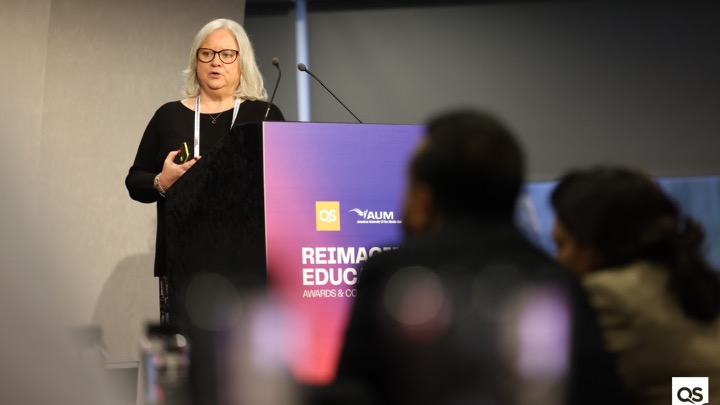
Digital4Business was proud to be selected and presented by Carmel Somers (Digital Technology Skills (DTSL)) in London on Monday, 1st December. With a large international audience, the conference brought together leaders from industry, academia, and policy for sessions on AI innovation, digital transformation, future workforce skills, and technology-driven business strategy. It also spotlighted education initiatives across medicine, biology, AI and digital technologies, along with new solutions that expand access for remote learners, students without internet access, young learners, neurodiverse learners, and broader diversity and inclusion needs.
The expert panel highlighted three standout features of the Professional Master’s Degree in Advanced Digital Technologies for Business: the integration of an AI-enabled career advisor to support learner progression, the deep collaboration between academia and industry ensuring real-world relevance for employers, and the programme’s unique dual accreditation – combining full EU academic accreditation with industry-recognised certification. It was a vibrant, forward-looking discussion in an exceptional central London venue, showcasing how Digital4Business is shaping the next generation of digitally fluent business professionals.
A global conversation on the future of skills
Across the three days, QS Reimagine Education 2025 brought together more than 700 changemakers from around the world – university leaders, employers, policymakers, innovators and students – all focused on one shared challenge: how to close the widening skills and opportunity gaps in global higher education.
Themes such as What Employers Want, Lifelong Learning in the New Skills Economy and The Strategic Advantage of Experiential Global Learning ran through the programme. Discussions repeatedly returned to the same conclusion: technical skills alone are not enough. Learners need adaptable, work-ready capabilities – from data and AI literacy to collaboration, resilience and problem-solving – that can evolve with a rapidly changing labour market.
Equitable partnerships were another key focus. Speakers explored whether current models of collaboration between institutions – and between the Global North and South – are fit for purpose in 2025. There was particular attention on emerging digital divides, not only between countries but within institutions themselves, as AI and advanced technologies reshape every aspect of education. The question was not if we should use AI in learning, but how to do so responsibly and inclusively.
From innovation to real-world impact
A strong message throughout the conference was that innovation in education must go beyond ideas and pilots to deliver measurable impact. Sessions on AI-ready universities, workforce planning and future student mobility trends asked institutions to reflect honestly on whether their strategies are truly preparing learners for the world of work in 2030 and beyond.
For Digital4Business, this focus on impact resonated strongly. Our Professional Master’s was designed from the outset with employers, based on an in-depth European needs analysis, and shaped to address real business challenges in data, AI and digital transformation. The AI-enabled career advisor showcased in London is a good example of this ethos: technology used not for its own sake, but to support learner progression, skills visibility and employability outcomes.
The global agenda also highlighted regions undergoing rapid transformation. A session on India’s higher education surge, for example, underlined how demographics and demand are reshaping the landscape, and how international partnerships can increase access, maintain affordability and drive innovation. These debates echoed many of the same drivers behind Digital4Business: cross-border collaboration, shared curriculum development and scalable digital learning models.
Youth, inclusion and the next generation of leaders
Alongside the main programme, the QS Impact Youth Summit brought students from around the world together to explore how the Sustainable Development Goals can be translated into practical action. Conversations centred on youth leadership in climate solutions, the role of technology and innovation in shaping sustainable futures, and the mindsets – such as emotional intelligence, adaptability and collaborative problem-solving – needed to create lasting change.
This youth-led perspective aligned closely with Digital4Business’ mission to empower early-career professionals, recent graduates and career-changers to become confident digital leaders. The emphasis on inclusion – from removing barriers for remote and low-connectivity learners to better supporting neurodiverse students – also reflects the values underpinning our fully online, work-friendly, pan-European programme design.
Looking ahead
The conference closed with a strong call for collective action: no single institution or initiative can solve the digital and education gaps alone. Progress depends on partnerships between universities, industry, governments and learners themselves.
Digital4Business is proud to be part of this global community of practice, and to have our Professional Master’s Degree in Advanced Digital Technologies for Business recognised on such an international stage. The insights and connections from QS Reimagine Education 2025 will inform how we continue to refine the programme, deepen collaboration with employers, and support our learners as they turn innovation into real-world impact.


)